The short version
- Step 1: resting energy (BMR) from the Mifflin–St Jeor formula, using your weight, height, age and sex.
- Step 2: multiply by your activity level, from 1.2 for mostly sitting to 1.725 for hard training most days.
- Step 3: to lose 1 lb a week, eat about 500 calories a day less. To gain, eat more.
Step 1: your resting energy
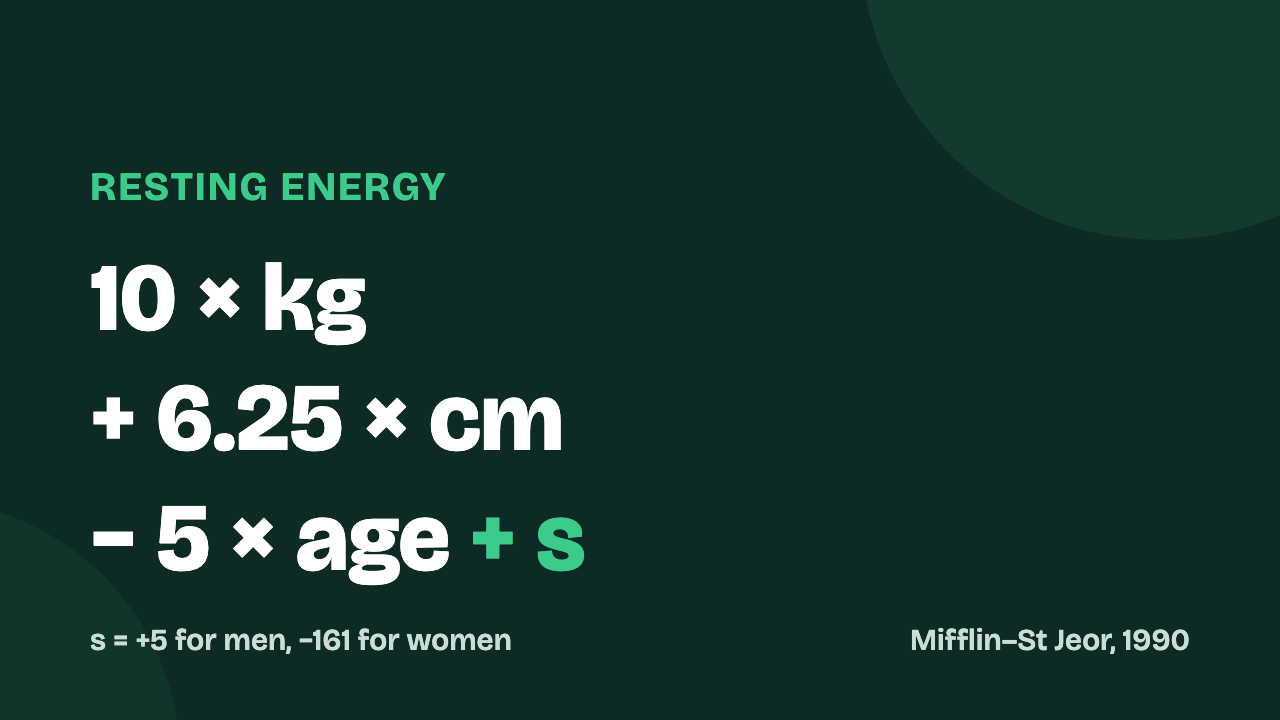
Your basal metabolic rate (BMR) is what your body burns at rest, just to keep you alive. The Mifflin–St Jeor formula, published in 1990, works it out from metric units:
Men: 10 × weight (kg) + 6.25 × height (cm) − 5 × age + 5
Women: 10 × weight (kg) + 6.25 × height (cm) − 5 × age − 161
To convert, multiply pounds by 0.4536 for kilograms, and inches by 2.54 for centimeters. A 2005 review of the common formulas found Mifflin–St Jeor the most reliable for healthy adults, which is why dietitians use it most. It is still an estimate: for some people it is off by 10% or more.
Step 2: your activity level
| Activity | What it means | Multiply by |
|---|---|---|
| Mostly sitting | Desk job, little exercise | 1.2 |
| Lightly active | 1–2 workouts a week | 1.375 |
| Active | 3–5 workouts a week | 1.55 |
| Very active | Hard training most days | 1.725 |
BMR × activity is your maintenance number: about what you burn in a day, and what you’d eat to stay the same weight. If you’re unsure, pick the lower level. It’s easy to overestimate activity, and the weekly check-in can raise your number later.
Step 3: your goal
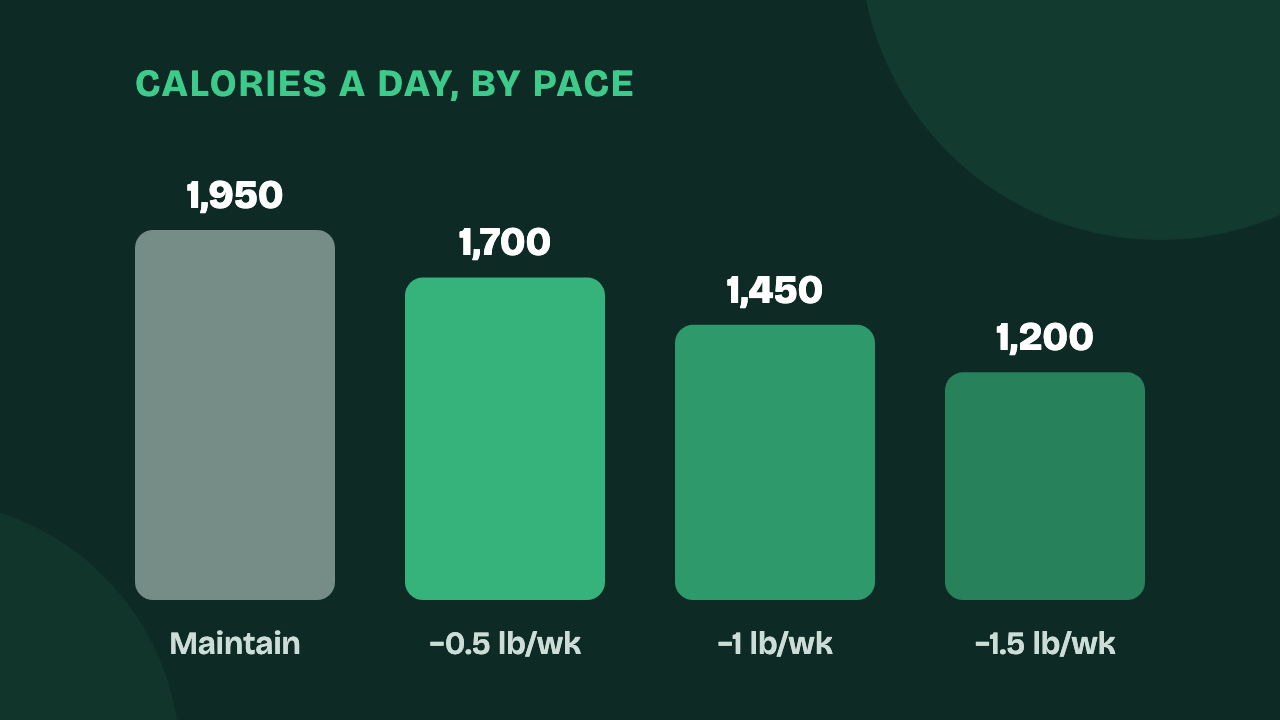
A pound of body fat is often counted as about 3,500 calories, so losing 1 lb a week takes about 500 calories a day below maintenance (3,500 ÷ 7). Half a pound a week is 250 a day; 1.5 lb is 750. To gain weight, add instead of subtract. How fast should you go? Here’s how to choose.
Two worked examples
A 35-year-old woman, 5′5″, 160 lb, lightly active, losing 1 lb a week. That’s 72.6 kg and 165.1 cm. BMR = 10 × 72.6 + 6.25 × 165.1 − 5 × 35 − 161 = 1,422 calories. Maintenance = 1,422 × 1.375 = 1,955. To lose 1 lb a week: 1,955 − 500 ≈ 1,450 calories a day, with 128 g of protein.
A 42-year-old man, 5′10″, 200 lb, active, staying at his weight. BMR = 1,813. Maintenance = 1,813 × 1.55 = 2,811, rounded to 2,810 calories a day, with 140 g of protein.
These are exactly the numbers the Vitametry app gives for these two people. The app also sets protein from your weight and goal, fat at 25% of calories, and carbs from the rest.
Why the formula is only the start
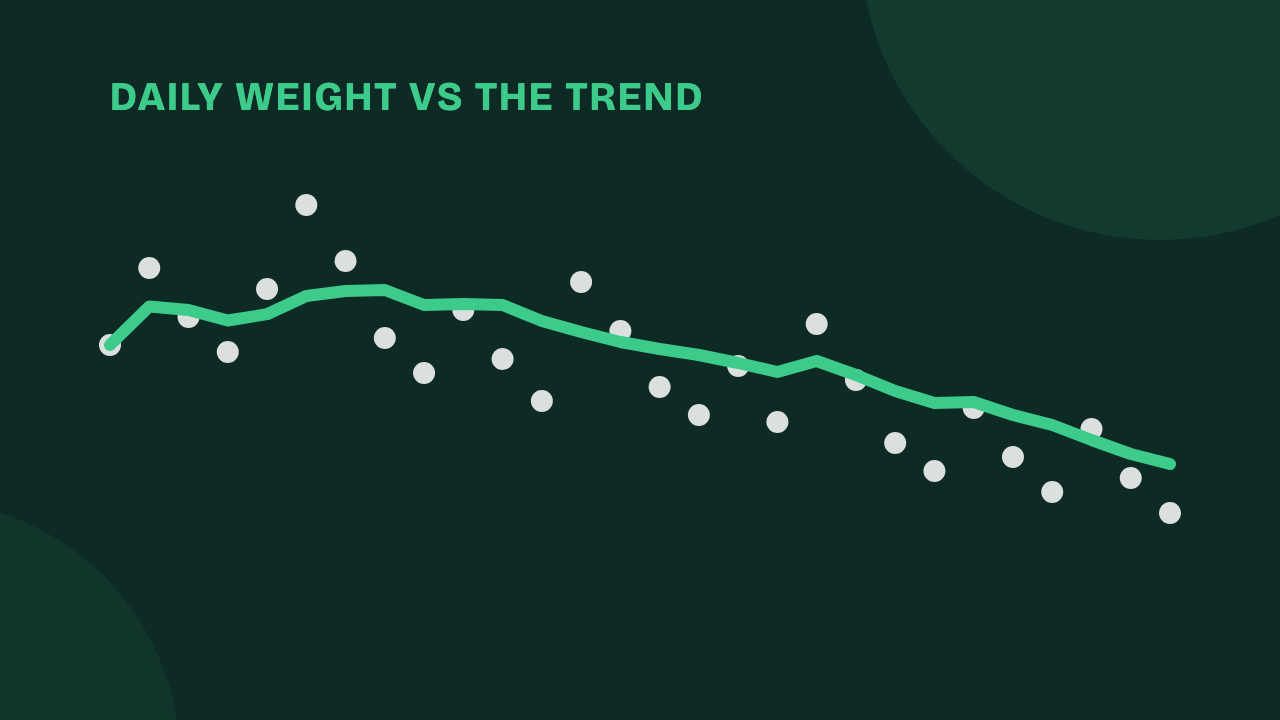
Every formula is an average. Your real burn depends on things it can’t see, like how much muscle you carry and how much you move outside workouts. That’s why the most useful number is the one your own scale tells you over a few weeks.
Vitametry’s weekly check-in compares how fast your weight is really changing with your plan. If you’re losing clearly slower than planned, it suggests 100 calories less a day; if much faster, 100 more. You decide whether to take it. Why a single weigh-in can mislead you.
Questions
What is the most accurate calorie formula?
For healthy adults, reviews have found the Mifflin–St Jeor equation the most reliable of the common formulas. It is still an estimate, so check it against your real weight trend.
How many calories should I eat to lose 1 pound a week?
About 500 calories a day less than your maintenance number, based on the rule of thumb that a pound of fat is about 3,500 calories.
What activity level should I choose?
If you’re unsure, choose the lower one. Most people overestimate their activity, and you can move up later if your weight drops faster than planned.
Sources
- Mifflin MD, St Jeor ST, Hill LA, Scott BJ, Daugherty SA, Koh YO. A new predictive equation for resting energy expenditure in healthy individuals. Am J Clin Nutr. 1990;51(2):241–247. doi.org/10.1093/ajcn/51.2.241
- Frankenfield D, Roth-Yousey L, Compher C. Comparison of predictive equations for resting metabolic rate in healthy nonobese and obese adults: a systematic review. J Am Diet Assoc. 2005;105(5):775–789. doi.org/10.1016/j.jada.2005.02.005
- U.S. Department of Agriculture and U.S. Department of Health and Human Services. Dietary Guidelines for Americans, 2025–2030 (January 2026). realfood.gov
General nutrition information, not medical advice. If you have a health condition, are pregnant, or have had an eating disorder, talk to your doctor or a registered dietitian before changing how you eat. Food values: 1,021 of Vitametry’s 1,141 foods come from USDA FoodData Central; the rest from other national food tables and product labels.