The short version
- Day-to-day changes are mostly water and the food still in your body, not fat.
- Weigh at the same time each morning, under the same conditions, and look at weekly averages.
- A trend over two to four weeks tells you far more than any single day.
What moves the scale
Gaining a pound of fat takes eating a few thousand calories more than you burn. Water, on the other hand, can move a pound or two in a day. Most of what you see from one morning to the next is water and food.
- Salt. A salty meal makes your body hold on to more water for a day or two. Takeout, pizza and soy sauce are common culprits. Where sodium hides.
- Carbs. Your muscles store carbohydrate as glycogen, and each gram is stored with water, roughly three grams of it. A high-carb day refills those stores and adds water weight; a low-carb day does the opposite. That’s much of the fast “loss” in the first week of a low-carb diet.
- Food in transit. The food and drink you’ve had but not yet digested has weight. A big dinner can still be on the scale the next morning.
- Hormones. Many women retain water in the days before their period, and the scale can read a few pounds higher.
- Exercise. A hard new workout can make muscles hold water while they repair, so weight can rise for a few days after you start training.
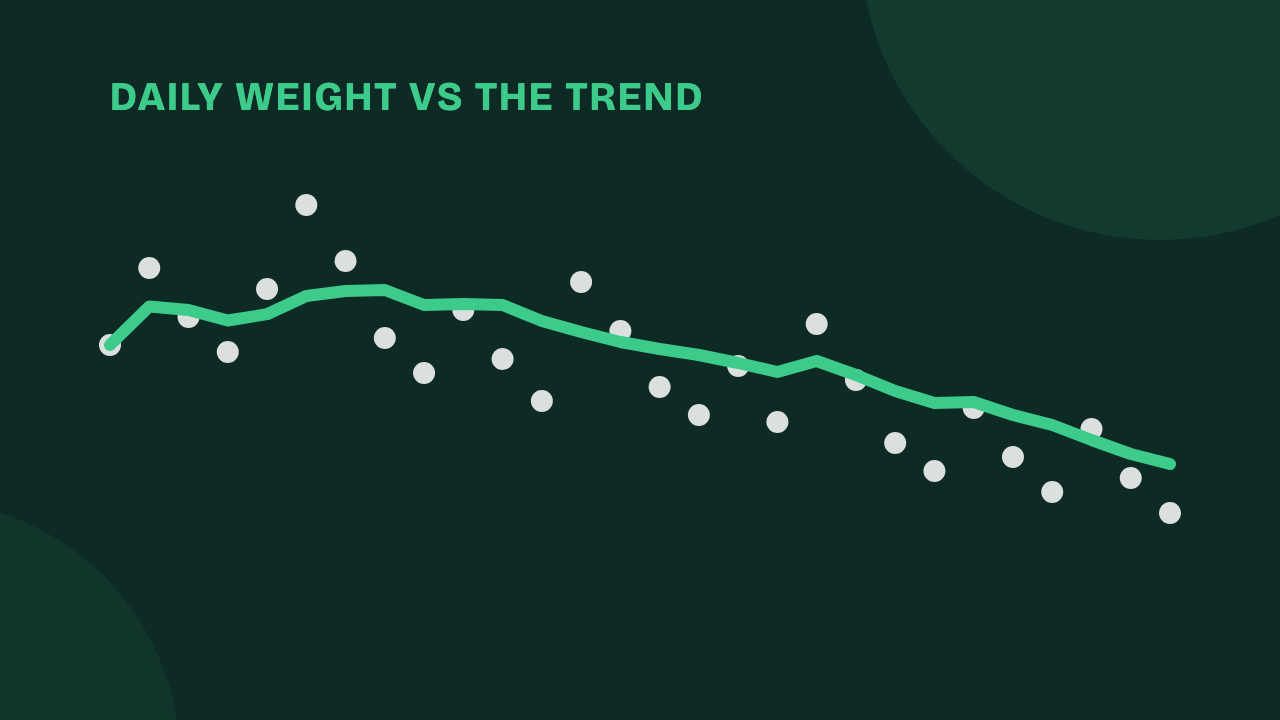
Example: four weeks of morning weigh-ins
- Each morning’s weight
- 7-day average
- From 182 lb to 179.6 lb over 4 weeks
How to weigh yourself so the numbers mean something
- Weigh in the morning, after using the bathroom and before eating or drinking.
- Use the same scale, on a hard, flat floor, wearing the same (or no) clothes.
- Write down every weigh-in, even the ones you don’t like. Skipping the high days makes the trend look better than it is.
- Compare averages, not days: this week’s average against last week’s.
Daily weighing gives the best average but can be stressful. Weighing once or twice a week works too, as long as you do it under the same conditions.
How Vitametry reads your weight
Vitametry asks for a weekly weigh-in, and your scale’s weight can come in by itself from Apple Health or Health Connect. The weekly check-in waits until it has two weekly weigh-ins, then compares your trend with your plan. One heavy morning won’t change your target. A trend that holds will.
Still going up after a month?
If your weight rises steadily for several weeks while you’re eating to your target, check your portions with a scale for a week. Bigger-than-logged portions and uncounted cooking oil are the most common reasons. Why a food scale helps.
Questions
How much can weight change in a day?
A pound or two is common, and more after a very salty or high-carb meal. This is mostly water and food, not fat.
When is the best time to weigh yourself?
In the morning, after using the bathroom and before eating or drinking, on the same scale each time.
Should I weigh myself every day?
Daily weighing gives the most reliable average if it doesn’t stress you. Once or twice a week also works when the conditions are the same.
Sources
- Olsson KE, Saltin B. Variation in total body water with muscle glycogen changes in man. Acta Physiol Scand. 1970;80(1):11–18. doi.org/10.1111/j.1748-1716.1970.tb04764.x
- Centers for Disease Control and Prevention. Steps for Losing Weight. www.cdc.gov/healthy-weight-growth/losing-weight/index.html
General nutrition information, not medical advice. If you have a health condition, are pregnant, or have had an eating disorder, talk to your doctor or a registered dietitian before changing how you eat. Food values: 1,021 of Vitametry’s 1,141 foods come from USDA FoodData Central; the rest from other national food tables and product labels.